Pearson Edexcel · GCSE · History
Course version: 1HI0 · Version from Sept 2016
C1500–c1700: Crime and punishment in early modern England - 1 Nature and…
Full specification wording
Option 10: c1500–c1700: Crime and punishment in early modern England - 1 Nature and changing definitions of criminal activity: New definitions of crime in the sixteenth century: vagabondage and witchcraft.
During the sixteenth century, societal changes led to new definitions of crime, notably vagabondage and witchcraft.
Checked against the Pearson Edexcel 1HI0 specification (opens in a new tab) on .
- Point 2 of 2
- 4 key terms
Study notes
From the checked teaching notes for this specification point.
The idea
During the sixteenth century, societal changes led to new definitions of crime, notably vagabondage and witchcraft. Economic pressures, population growth, and the closure of monasteries increased the number of wandering poor. The authorities feared these 'vagabonds' as a threat to social order, leading to harsh laws like the 1547 Vagrancy Act. Similarly, witchcraft became a legally defined secular crime. The 1542 Witchcraft Act made it a capital offence, driven by religious changes and economic tensions. Towards the end of the century, publications like James VI of Scotland's 'Daemonologie' (1597) further fuelled fears, influencing later laws.
What earns the marks
- Explain the economic and social causes of vagabondage, such as population growth, inflation, and the dissolution of the monasteries.
- Describe the legislative response to vagabondage, including the distinction between the 'deserving' and 'undeserving' poor.
- Identify the reasons for the criminalisation of witchcraft, including religious changes, economic tensions, and the publication of texts like 'Daemonologie'.
- Analyse how both vagabondage and witchcraft were driven by the authorities' fear of social breakdown and loss of control.
Common mistakes and how to put them right
Stating that witchcraft was a completely new concept.
Put it right: Belief in magic existed earlier, but it was newly defined as a serious secular crime punishable by death in this period.
Treating all poor people as vagabonds.
Put it right: The law increasingly distinguished between the 'deserving poor' who were unable to work and 'sturdy beggars' or vagabonds who were able but unemployed.
Claiming the 1542 Witchcraft Act was caused by James I's 'Daemonologie'.
Put it right: The 1542 Act predates 'Daemonologie' (1597), which instead influenced later seventeenth-century legislation like the 1604 Act.
Exam tips
- Use specific legislation, such as the 1542 Witchcraft Act or the 1572 Vagabonds Act, to support your explanations.
- Connect the rise in these crimes to broader societal anxieties, such as fear of rebellion or religious instability.
- Compare the motivations behind criminalising vagabondage, which was about economic and social control, with witchcraft, which stemmed from religious and supernatural fear.
Try the lesson
The start of the Option 10: c1500–c1700: Crime and punishment in early modern England - 1 Nature and changing definitions of criminal activity: New definitions of crime in the sixteenth century: vagabondage and witchcraft. lesson, made from checked teaching notes for this specification point.
Have a go first
In the sixteenth century, what was a 'vagabond' or 'vagrant'?
Listen
During the sixteenth century, societal changes led to new definitions of crime, notably vagabondage and witchcraft. Economic pressures, population growth, and the closure of monasteries increased the number of wandering poor. The authorities feared these 'vagabonds' as a threat to social order, leading to harsh laws like the 1547 Vagrancy Act. Similarly, witchcraft became a legally defined secular crime. The 1542 Witchcraft Act made it a capital offence, driven by religious changes and economic tensions. Towards the end of the century, publications like James VI of Scotland's 'Daemonologie' (1597) further fuelled fears, influencing later laws. A strong answer earns marks for these points. Explain the economic and social causes of vagabondage, such as population growth, inflation, and the dissolution of the monasteries. Describe the legislative response to vagabondage, including the distinction between the 'deserving' and 'undeserving' poor. Identify the reasons for the criminalisation of witchcraft, including religious changes, economic tensions, and the publication of texts like 'Daemonologie'. Analyse how both vagabondage and witchcraft were driven by the authorities' fear of social breakdown and loss of control. A common slip: Claiming the 1542 Witchcraft Act was caused by James I's 'Daemonologie'. Instead, the 1542 Act predates 'Daemonologie' (1597), which instead influenced later seventeenth-century legislation like the 1604 Act. Exam tip: Use specific legislation, such as the 1542 Witchcraft Act or the 1572 Vagabonds Act, to support your explanations.
See it
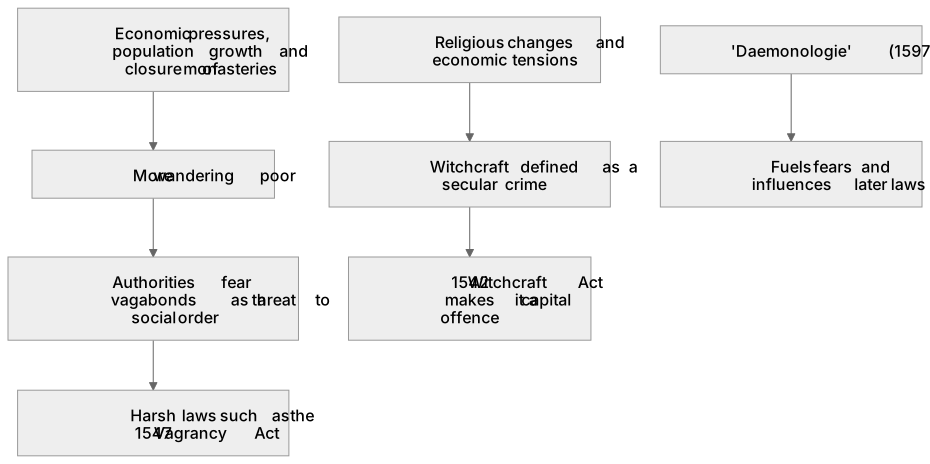
Put the events in order
Put these events in the order they happened, earliest first.
- 1. James VI of Scotland published 'Daemonologie'
- 2. Witchcraft Act made witchcraft a capital offence
- 3. Vagabonds Act passed
- 4. Vagrancy Act introduced harsh laws against vagabonds
Key words
Say what each word means before you turn the card.
Vagabondage
Try answering aloud or in your head before turning the card.
Witchcraft
Try answering aloud or in your head before turning the card.
Deserving poor
Try answering aloud or in your head before turning the card.
Daemonologie
Try answering aloud or in your head before turning the card.
See every definition
- Vagabondage
- The wandering poor, whose numbers grew through economic pressures, population growth and the closure of monasteries, and whom the authorities feared as a threat to social order.
- Witchcraft
- A legally defined secular crime made a capital offence by the 1542 Witchcraft Act, driven by religious changes and economic tensions.
- Deserving poor
- People who were unable to work, distinguished by the law from 'sturdy beggars' or vagabonds who were able but unemployed.
- Daemonologie
- A publication by James VI of Scotland in 1597 that further fuelled fears of witchcraft and influenced later laws.
Label the diagram
Some boxes have lost their names. Pick the right name for each number.
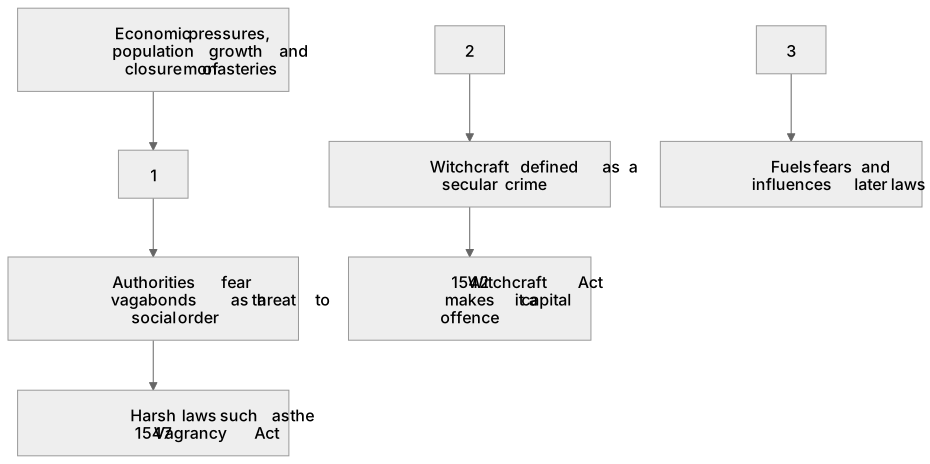
1Box 1
2Box 2
3Box 3
There is more to this lesson
The full lesson goes on to check your understanding and help you earn the marks. Create a free account to carry on, with your progress saved.
A week of Premium from your first lesson · Then the free plan continues · No card, no charge
Test your understanding of Option 10: c1500–c1700: Crime and punishment in early modern England - 1 Nature and changing definitions of criminal activity: New definitions of crime in the sixteenth century: vagabondage and witchcraft.
Active recall beats re-reading. Take an instant quiz now to test what you’ve learned and lock it into long-term memory.
A week of Premium from your first lesson · Then the free plan continues · No card, no charge